If you run HGVs over 12 tonnes into Greater London, you already know the Progressive Safe System exists. The question most operators actually have isn't "what is it." It's "what's this really going to cost me, and is it worth it on trucks that barely touch London."
Fair question. Let's go through it properly.
We've fitted hundreds of these, DVS and now PSS, over the last few years. So this is the version from the install bay, not the version from a brochure. Both sides. What the kit does, what it costs, and where operators quietly think it's overkill.
Progressive Safe System explained, in plain terms
PSS is Phase 2 of Transport for London's Direct Vision Standard. It's been enforced since 28 October 2024. The grace period for booked installs ran out on 4 May 2025, so it's fully live now.
The short version: the minimum DVS star rating to get an HGV Safety Permit without extra kit went up to 3 stars. If your over-12-tonne vehicle is rated 0, 1, or 2 stars and goes into Greater London, it needs the Progressive Safe System fitted to get a permit.
No permit, and the FINES start. (Source: TfL Direct Vision Standard guidance for operators.)
The operator fine drops to £275 if you pay within 14 days. The driver still gets stung separately. (Source: TfL.)
What the kit actually has to do
TfL specifies a set of components. Not a brand, a set of jobs the kit has to do. The headline ones:
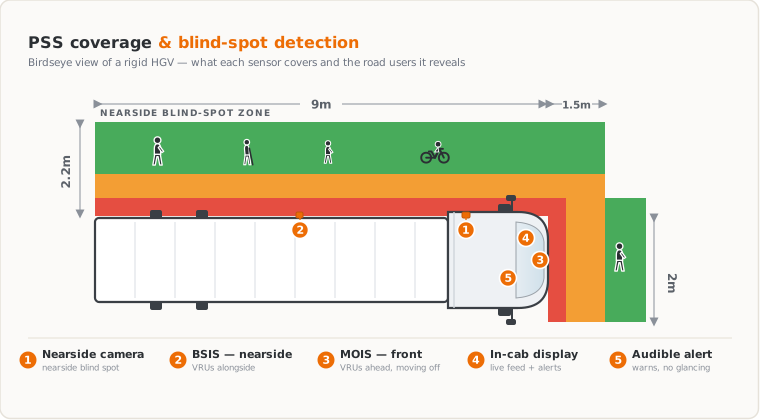
- A Camera Monitoring System (CMS) to kill the nearside blind spot, and/or Class V and VI mirrors front and nearside
- A Blind Spot Information System (BSIS) that warns the driver about cyclists and pedestrians down the nearside
- A Moving Off Information System (MOIS) that warns when pulling away
- Audible and visual driver alerts
- Side under-run protection and the right external signage
One thing people miss: if you fitted the old 2019 Safe System, some of that kit often needs upgrading or stripping out so the driver isn't drowning in alerts. More beeps is not more compliant. It's just more noise in the cab.
For the permit itself, you submit two photos of the installed hardware plus a sensor functionality statement. Get the photos wrong and the application bounces back, which is its own little time sink.
How much does PSS cost per vehicle?
Here's the bit operators actually want, with no gloss on it.
Kit and install run from around a grand for the budget end, up to £2,000-plus for the premium branded systems. For a decent system, realistically you're looking at £1,400 to £1,600-ish per vehicle, plus the downtime.
The downtime is the easy part. About half a day to fit, whatever the system. A good installer comes to your depot, so you're not losing the truck to travel on top of the fit.
Cheap kit is cheap kit. There are exceptions, the odd mid-priced radar system that's genuinely good and sits at about half the price of the big-name premium one. BUT a lot of the budget radars and some of the budget AI cameras, we're forever going back to service them or recalibrate them. The saving on day one quietly turns into callouts over the next two years.
With the premium brand, part of what you're paying for is the name. The kit's good. You're just not getting it cheap.
Radar vs camera vs AI: what actually differs
They all look similar on the shelf. They don't all behave the same on the truck. The difference is usually firmware and how much the manufacturer has actually worked on it, not the box it comes in.
| System type | How it behaves | Watch out for |
|---|---|---|
| Radar (budget) | Audible beep plus a position on a small display. Simple, cheap to fit. | The cheaper ones often need repeat servicing and recalibration. |
| Radar (mid / premium) | Same idea, better build. A good mid-priced one rivals the big name at roughly half the price. | With the premium brand you pay partly for the name. |
| AI camera | Visual feed plus a red alert light on the blind-side pillar. Smarter detection of real road users. | Quality lives in the firmware. Same-looking kit varies hugely by how much the company has tuned it. |
If you take one thing from this section: two AI camera systems can look identical and perform nothing alike. Ask what firmware version it's on and how often they update it. The good ones are constantly tuning the detection. The bad ones shipped once and went quiet.
Drivers, training, and alert fatigue
Operators worry about drivers being buried in beeps in heavy traffic. It's a real thing. Too many false alerts and the driver tunes the whole lot out, which defeats the point.
Training-wise, it's lighter than people fear. Radar just tells the driver someone's there with a beep and a position. Cameras give the visual plus that red pillar light. There's no fancy fatigue-monitoring built into PSS kit. A proper run-through with the driver, or a clear one-pager in the cab, usually does it.
Will it talk to my telematics?
Short answer, mostly no. PSS is its own standalone safety system. It isn't a tracking layer and it isn't trying to be.
You can wire AI cameras through the DVR to log events, in theory. In practice, every time we've run it to the in-cab screen, the screen response is too slow to lean on as a live warning. By the time it's reacted, the moment's gone. Treat PSS as its own thing. Keep your tracking and compliance stack separate.
PSS isn't a fleet management system and it won't pretend to be one. It does one job: indirect vision and warnings around the truck in a city, so you don't have a fatal blind-spot incident and lose far more than the cost of the kit. Whether that job is worth £1.5k on a truck that touches London twice a year is a genuinely fair thing to grumble about.
Is PSS worth it? Both sides, honestly
We fit this stuff for a living, so you'd expect us to wave the flag for it. We won't pretend the operator frustration isn't real, because it is, and we hear it on nearly every job.
The case for it: London's a brutal place for nearside collisions with cyclists and pedestrians. The kit genuinely addresses blind spots where direct vision is poor. And the downside of getting it wrong isn't a fine, it's a person under a trailer. That reframes the £1.5k pretty quickly.
The case against it: it's another capital cost landing on already tiny margins. For a fleet that's mostly national with the odd London drop, it can feel like paying full whack for a couple of routes. And the "national rollout" worry is the one operators raise most. Nobody wants to kit out the whole fleet for London and then watch the same rules turn up everywhere else anyway.
Both of those can be true at once. Safety improvement in principle, proportionality argument in practice. That's the actual tension, and anyone telling you it's simple is selling something.
The questions worth asking before you buy
If you're weighing up suppliers, these are the ones that separate a good fit from a regret:
-
What's the all-in cost per vehicle
Kit, install, downtime, and likely maintenance over a couple of years. Not just the sticker price.
-
Can you come to my depot, and how long is the truck down
Half a day is normal. Depot fitting saves you the travel hit on top.
-
What firmware is the AI on, and how often do you update it
This is the single biggest quality tell on camera systems. Vague answer, walk away.
-
What happens when a sensor fails on the road
The system must alert the driver it's faulty. If it's down and you're caught in the zone, you're not compliant and the fine stands.
-
For a bigger fleet, can I trial it first
Reasonable to ask on a decent-sized fleet. It's compulsory kit, so it's rarely sold on demos, but a couple of vehicles to test isn't unreasonable.
Get a Straight Answer on Your Fleet
Tell us your vehicles and routes and we'll tell you honestly what needs PSS, what doesn't, and what it'll cost. No ticket queue. You get a person who answers.
Talk to the Team Free Compliance ScorecardThe bottom line
PSS addresses a real risk. It also lands a real cost on operators who are already watching every quid. Both things are true.
If your trucks run London, you don't have a choice, so the job is choosing kit that won't have you back in the workshop every other month. If they barely touch it, the maths is tighter and worth doing properly before you spend.
Either way, buy on quality and firmware, not on the cheapest line on the quote. The cheap one usually costs more by year two.
Has the PSS cost stacked up for the work you actually do in London? Or does it feel like paying full price for a couple of routes? Tell us where you've landed on it, we're hearing both, and we might be missing something.
Rules and technical specs change. Always check the current TfL Direct Vision Standard guidance for operators before you apply for a permit.
Frequently Asked Questions
Kit and install land anywhere from around £1,000 for budget systems to £2,000-plus for premium branded ones. The realistic average for a decent system is roughly £1,400 to £1,600 per vehicle, plus downtime. Most installs take about half a day.
About half a day for any of the systems. A good installer can usually come to your depot, so you are not losing the vehicle to travel time on top of the fit.
Mostly no. PSS is a standalone safety system. You can wire AI cameras through the DVR to log events, but in practice the in-cab screen response is too slow to rely on as a live warning. Treat PSS as its own layer, separate from your tracking stack.
No. The system must have a built-in fault alert that tells the driver it is not working. The moment it shows faulty, it has to be serviced. If you are caught in London with it not working, that is a £550 fine to the operator and £130 to the driver.
Realistically, no. Because the kit is effectively compulsory to enter the zones, insurers do not tend to treat it as an optional safety upgrade you get credit for. Fit it for compliance and incident protection, not for a premium discount.
Sometimes, for a decent-sized fleet. It is not usually sold on demos though, because if you run in the zone you have to have it. For a larger fleet, a short trial across a couple of vehicles is reasonable to ask for.
If an over-12-tonne vehicle rated 0, 1, or 2 stars enters Greater London at all, it needs a valid HGV Safety Permit, which means PSS fitted. There is no occasional-use exemption. If a vehicle never enters the zone, it does not need PSS. So for a mixed national fleet, the honest question is which specific vehicles actually do the London work, and fitting only those.